History of The Tiara


Tiaras can be traced back to antiquity when they crowned heads of royal mummies in ancient Egypt, and Grecian goldsmiths created them for statues of their Gods and priests. The Greeks awarded tiaras to the victors of contests, and people of high rank wore them at special occasions. The Romans also adopted the tiara, and used it to denote rank and honour.

In Napoleonic times, tiaras which were made for women of the court were inspired by ancient Rome, designs being symmetrical and simple, with decorative elements such as laurel and olive leaves.

After 1815, the restored Bourbon monarchs encouraged displays of magnificent jewellery at the French court. English jewellers created some of the finest, most delicate and ethereal tiaras of the 19th Century. This period also marked the first time that tiaras became associated with weddings.

Queen Victoria led England and the Empire during the 1840’s into a time of growing prosperity. Also prosperous, France declared the Second Empire in 1852 with the crowning of Emperor Napoleon III, heralding a new era of brilliance for Parisian high-society. Across Europe, court life flourished and dazzling jewellery became de rigueur, illuminating the age.

In the latter part of the 19th Century, Russian aristocracy took the opulence of European courts to even greater heights, outdoing other nations in displays of wealth and luxury. The Grand Duchesses ordered breathtaking designs from the jewellers of St. Petersburg and Paris.

In the first decade of the 20th Century, more tiaras were worn than at any other time. New tiaras were made and old ones reset for the coronations of King Edward VII (1902) and King George V (1911), and ladies circulated at the “tiara nights” at the Paris Opera.

Tiaras began to be replaced by simpler bandeaux and aigrettes by WW1, but in spite of the great social and economic changes brought about at this time, they endured. Jewellers rejuvenated designs to work with the bobbed hair and pared down clothing of the 1920s and took inspiration from the exotic and unusual, geometrics and the colour contrasts of art deco. The tiara revival of the 1930s came to an end with the outbreak of WW2, after which they sadly never regained formal prominence, though there has been modern resurgence in tiaras and crowns for weddings and other special occasions, often being the treasured sparkling glory of radiant brides and bridesmaids.

Historically tiaras were designed to showcase priceless jewels as gleaming status symbols. Alternative movements in jewellery design have challenged this approach since the mid-19th Century, emphasising design and craftsmanship, moving the tiara away from the exclusive circles of only those who could afford to wear diamonds and gold on their head, to more affordable pieces designed to be worn and enjoyed by many.

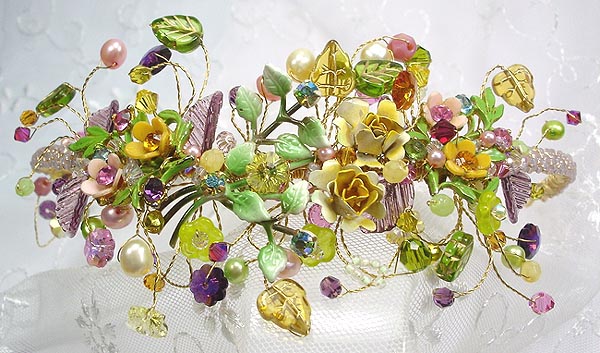
Artists today create marvellous tiaras with exquisite materials and innovative designs, many of which are worn at weddings, later serving as precious mementoes of special days, future heirlooms, or pieces that can be converted into a necklace and so continue to give pleasure to the wearer. I hope the tiaras on my web site will show you what is possible, and what is possible is only limited by imagination…

Stephanie Lewis-Cooper


 Revised 01/11/01